
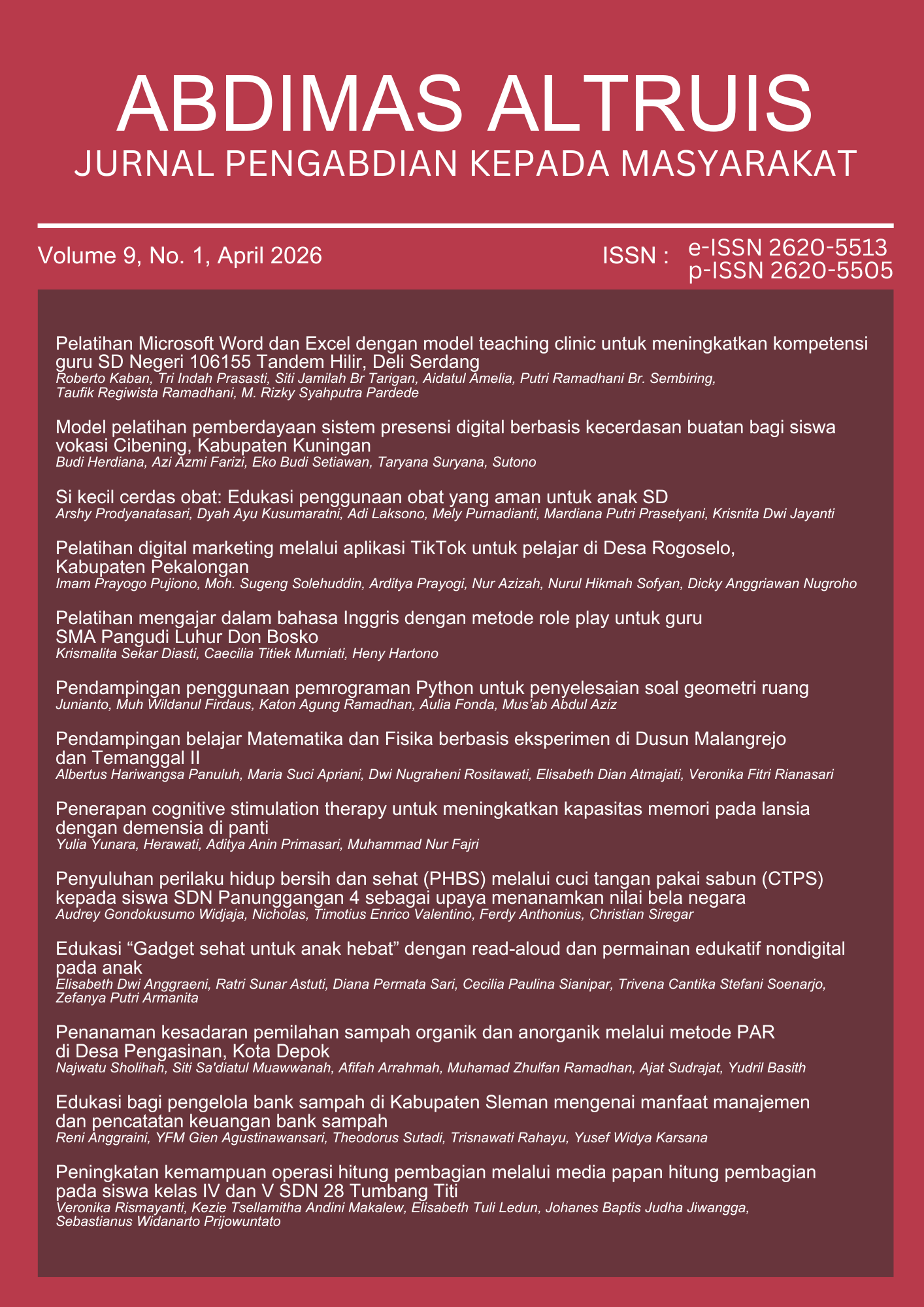
Edukasi “Gadget sehat untuk anak hebat” dengan read-aloud dan permainan edukatif nondigital pada anak
Article Sidebar
Main Article Content
Abstract
Excessive gadget use in early childhood can negatively affect their motor, social, and emotional development. Based on a survey conducted at GKJ Condongcatur, 60% of parents reported signs of gadget dependency in their children, such as crying when the gadget was taken away and difficulty concentrating. The community service activity titled “Healthy Gadgets for Great Kids” aimed to increase Sunday School children’s understanding of healthy gadget use while encouraging active play and social interaction. The methods used included interactive education activities through read-aloud storytelling and educational games such as assembling puzzles, flashcards, daily schedule clocks, and playing “Simon Says”. The results showed children’s understanding of screen time limits, recognition of good and bad behaviors, and awareness of alternative activities such as outdoor play and helping parents. Children also demonstrated high enthusiasm and interaction with these educational activities. This program shows potential as a community education model to foster healthy digital awareness from an early age.
Downloads
Article Details
Section

This work is licensed under a Creative Commons Attribution-ShareAlike 4.0 International License.
How to Cite
References
Alotaibi, M. S. (2024). Game-based learning in early childhood education: A systematic review and meta-analysis. Frontiers in Psychology, 15, 1307881, 1–11. https://doi.org/10.3389/fpsyg.2024.1307881
Bhat, A. N., Tahir, S., & Kumar, R. (2023). The influence of early exposure to smart gadgets on children. Journal of Propulsion Technology, 44(2), 235–240. https://doi.org/10.52783/tjjpt.v44.i2.141
Chaibal, S., & Chaiyakul, S. (2022). The association between smartphone and tablet usage and children development. Acta Psychologica, 228, Article 103646. https://doi.org/10.1016/j.actpsy.2022.103646
Domoff, S. E., Borgen, A. L., Foley, R. P., & Maffett, A. (2019). Excessive use of mobile devices and children’s physical health. Human Behavior and Emerging Technologies, 1(2), 169–175. https://doi.org/10.1002/hbe2.145
Lai, N. K., Ang, T. F., Por, L. Y., & Liew, C. S. (2018). The impact of play on child development - a literature review. European Early Childhood Education Research Journal, 26(5), 625–643. https://doi.org/10.1080/1350293X.2018.1522479
Radesky, J. S., & Christakis, D. A. (2016). Increased screen time: Implications for early childhood development and behavior. Pediatric Clinics of North America, 63(5), 827–839. https://doi.org/10.1016/j.pcl.2016.06.006
Salih, B. H. (2025). The impact of the simon says game on attention and listening skills in Iraqi primary school students: A pilot study. Journal of Higher Education and Academic Advancement, 2(7), 321–331. https://doi.org/10.61796/ejheaa.v2i7.1339
Setiawati, E., Mama, A. T., & Usmaedi. (2023). Patterns of gadget use in preschool children’s learning: An overview of sociology of education. Journal of Higher Education Theory and Practice, 23(10), 39–48. https://doi.org/10.33423/jhetp.v23i10.6180
Talan, T., Doğan, Y., & Batdı, V. (2020). Efficiency of digital and non-digital educational games: A comparative meta-analysis and a meta-thematic analysis. Journal of Research on Technology in Education, 52(4), 474–514. https://doi.org/10.1080/15391523.2020.1743798
Terras, M. M., & Ramsay, J. (2016). Family digital literacy practices and children’s mobile phone use. Frontiers in Psychology, 7, Article 1957. https://doi.org/10.3389/fpsyg.2016.01957
Tokarchuk, Y. A., Salomatova, O. V., & Gavrilova, E. V. (2024). The use of board games and digital games preschoolers: Results of a survey of Russian parents. Psychological-educational Studies, 16(1), 76–95. https://doi.org/10.17759/psyedu.2024160105
Zuceti, H. R. M., Juliana, H.-R. J., Sotelo-Núñez, A. C., López-Regalado, O., Enrique, B.-C. L., & Alberto, M.-T. D. (2024). Bibliometric analysis on educational games in preschool children’s learning. Nanotechnology Perceptions, 20(S14), 706–724. https://doi.org/10.62441/nano-ntp.vi.2846